Enterprise Design Leadership
Embedding Design at Scale, resulting in 80% customer value delivery
Building design capability at scale through Product U — co-creating curriculum, metrics, and delivery across four global offices, training 2,000+ people and embedding user-centricity into organizational structure.
Problem
Hiring design leaders wasn’t enough — without shared methods, tools, and culture, delivery and customer outcomes still fell short; “design thinking” had to become how teams actually worked.
Scope
Design Lead to Design Manager: co-built Product U (curriculum, metrics, delivery), embedded user-centricity in structure, and ran research and facilitation across global offices.
Delivery
Thousands trained with measurable shifts in adoption, satisfaction, OKRs, and team health — moving the org toward customer value delivery and sustainable design practice.
Outcomes
Showed that capability-building at scale can move OKRs, team health, and agile/design maturity — not just classroom satisfaction — when training is tied to real work and leadership accountability.
2,000+
People trained globally, with measurable improvements in OKRs, team health, and design and agile maturity
90%
Adoption
95%
Satisfaction
30 days
Impact on engineer onboarding redesign
90 days
Cultural integration on engineer employee experience redesign
100%
User satisfaction
Skills
Enterprise & CoE context
Enterprise Applications
Customer Experience
Business Operations
Center of Excellence
Research, service & practice craft
User Research
Jobs-to-be-done research
Service Design
Design Thinking
Workshop Facilitation
Curriculum Design
Learning Design
Strategy, org change & culture
Design Strategy
Organizational Transformation
Organizational Design
Organizational Agility
Digital Transformation
User-Centric Culture
Enablement
Systems, analytics & leadership
Design Systems
Systems Design
Data Analytics
Design Ops
Team Leadership
Soft skills
Partnership, facilitation, and leadership habits — expand for the full list.
Adaptability
Agile & delivery literacy
Building trust in teams
Client & founder partnership
Coaching
Conflict navigation
Cross-cultural collaboration
Cross-functional collaboration
Curiosity & learning agility
Delegation & empowerment
Empathy & listening
Executive partnership
Executive presence
Facilitation & listening sessions
Giving & receiving feedback
Inclusive collaboration
Influence without authority
Mentoring
Navigating ambiguity
Ownership & accountability
Prioritization & tradeoffs
Product & engineering partnership
Reliability
Resilience
Stakeholder alignment
Strategic communication
Storytelling & narrative
Systems thinking
Talent development
Vision & narrative alignment
Context
Organizations hire design talent but struggle to embed user-centered ways of working. Products and services often miss customer expectations because design thinking isn't built into structure, tools, and culture.
I partnered with senior leadership as Design Lead (later Design Manager) to change that. The work evolved through two phases along an arc: evangelism → infrastructure → product — building design capability at scale and embedding user-centricity into organizational structure.
"Strong mission and vision act as a north star — but what actually moves organizations forward is the culture and structures that empower teams to do their best work."
Challenge
How might we move beyond evangelism to make user-centered ways of working the default?
Collaboration & ownership
What I owned, who I led, and who I worked with.
- Accountability: Co-created Product U end-to-end — curriculum, success metrics, and delivery across four global offices — plus research and UX strategy that informed org structure and ways of working.
- Team: Facilitation at scale (remote and in-person); coaching squads on lean playbooks, agile/design alignment, and center-of-excellence practices.
- Stakeholders: Partnered with senior leadership to align business strategy with team outcomes; triangulated jobs-to-be-done with KPIs and unmet user needs.
Approach
Product U & global training
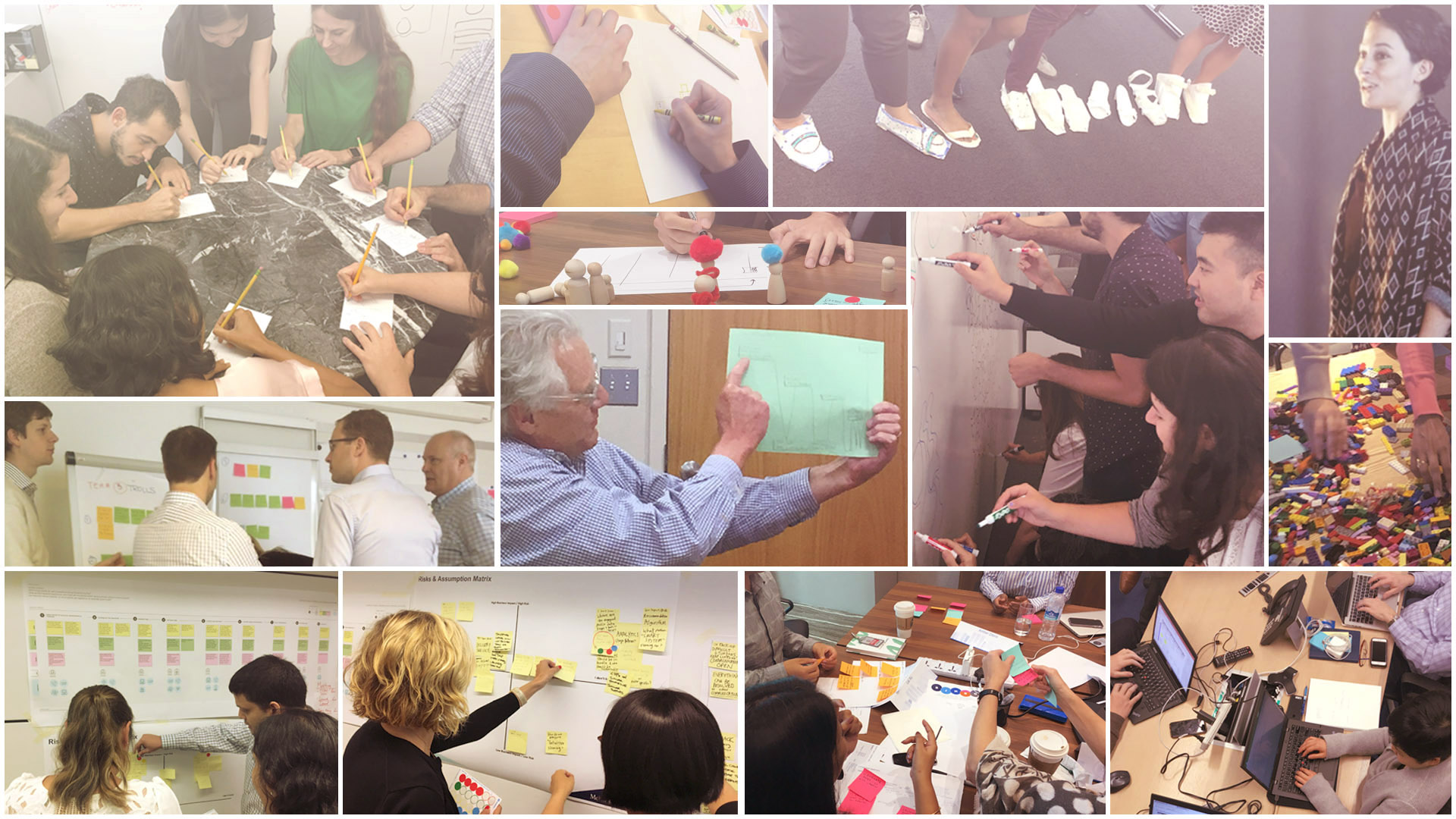
Function leadership wanted to become user-centric and transform their ways of working to deliver greater impact. I co-created Product U: curriculum, metrics, and delivery across four global offices — training 2,000+ people while measuring behavior change and impact metrics. Much of this work happened remotely across time zones, requiring a new approach to facilitation. I designed immersive virtual workshops using Miro and Zoom that maintained energy and collaboration despite distance — skills that became essential as the organization shifted to distributed work. In-person facilitation spanned four continents, adapting to local contexts while maintaining consistent principles and increasing team health.
Embedding user-centricity
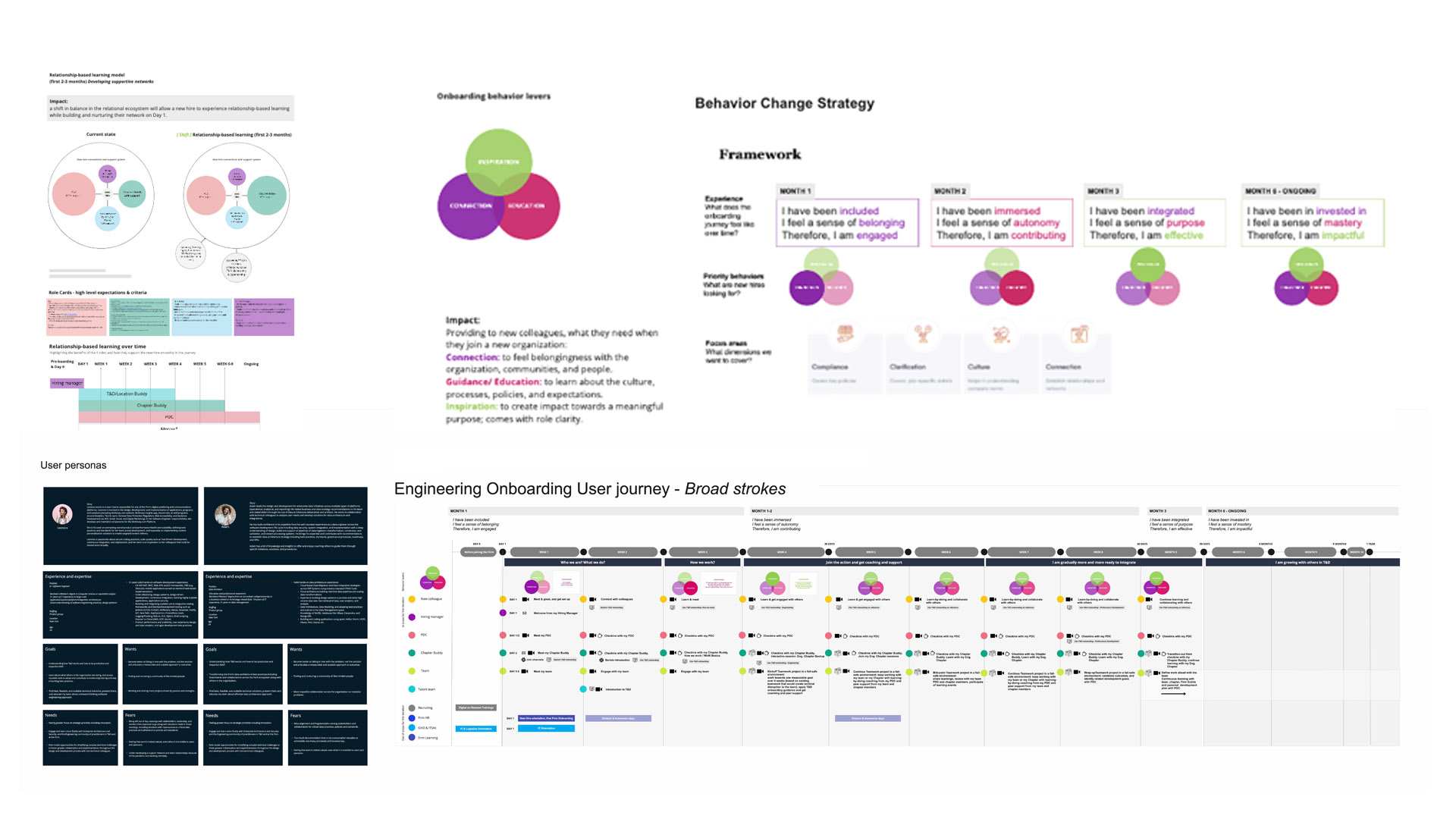
I embedded user-centricity into organizational structure and aligned business strategy with team outcomes by delivering research and UX strategy recommendations. Research identified friction points in team organization and informed restructuring recommendations and a simplified agile/design framework practical for immediate adoption. I led jobs-to-be-done research triangulated with KPIs, business opportunities, and users' unmet needs.
Ways of working & center of excellence
I provided design UX for ways of working across the function: mentored teams through design and agile ops, developed lean playbooks with core principles, and encouraged teams to codify their design-led ways of working. I simplified agile/design frameworks for cross-functional squads to share best practices and terminology, redesigned engineer onboarding using behavior design strategy, and led design capabilities for a center of excellence for user-centered strategy, OKRs, and team health practices.
Results & learnings
Business takeaway
The real lever is people and systems together: modeling the behaviors you want, creating room to adapt, and providing enough structure to scale collaboration.
What I’d repeat on the next engagement
- Change is a product problem. Research, iteration, and co-creation apply to org change as much as to customer-facing work.
- Agility is a mindset before it’s a framework. Tools help only after teams know how to think and adapt.
- Creativity and play aren’t optional extras. They unlock better outcomes when the culture allows them.
I'm interested in how AI and agentic tools can speed execution while qualitative research and human-centered practice stay non-negotiable — in a rush to automate, thoughtful design is still the differentiator.
Testimonials
Julie Rozof
Director II, Global Tech Ecosystem Strategic Planning & Transformation
Manager — McKinsey WOW · February 8, 2026
On McKinsey's Technology & Digital "Way of Working" transformation: Azul "co-created and delivered user-centered curriculum and workshops that trained 2,000+ colleagues across four continents—driving 90% adoption and 95% satisfaction in new ways of working." She also led jobs-to-be-done research informing strategy, redesigned engineering onboarding from ~90 days to ~30 days through behavior design, and codified tools and frameworks for the center of excellence.
Organizational Transformation
Learning Design
User Research
Jobs-to-be-done research
Workshop Facilitation
Behavior Design
Center of Excellence
Curriculum Design
Enablement
Organizational Design
As former Executive Director of 30 Weeks, she writes that Azul "jumped in without hesitation" and learned quickly how to turn an ambitious vision into a viable company—then launched Wonderpath Studio. After McKinsey reconnection: "What distinguishes Azul from other design leaders I've encountered is how she frames problems before solving them. She asks: Who does this serve? What system does it change? Will it last?"
Team Leadership
Learning Design
Creative Technology
Organizational Transformation
Design Strategy
Enterprise Applications
Design Thinking