Enterprise Design Leadership
AI Coaching integrations that provided 70% faster time-to-value
Leading design strategy while hands-on across research, prototyping, and delivery — and mentoring a cross-functional team to ship an AI Coach embedded in three solutions in under six months.
Problem
Leadership development was slow, generic, and disconnected from leaders’ real work — so organizations struggled to build capabilities at the pace of change.
Scope
Design Manager: design strategy, hands-on UX for AI-assisted learning, cross-functional alignment — plus mentoring and design ops so the team could ship.
Delivery
Three AI-powered coaching experiences shipped in six months; measurable gains in speed to value, reach, and satisfaction — with a path to scale globally.
Outcomes
Validated that AI-assisted coaching could deliver faster, more relevant capability building than traditional training — with strong adoption when embedded in real workflows.
70%
Faster time-to-value than traditional training
3,000+
Managers accelerated in leadership growth
6–7/7
Satisfaction when embedded in workflows
Skills
Domains & outcomes
Enterprise Applications
Customer Experience
Financial Performance
Learning & research craft
Learning Design
Mixed Methods User Research
AI product & responsible design
AI / LLM UX
AI integration
Design Systems
AI Ethics & Guardrails
Strategy, leadership & transformation
Design Strategy
Team Leadership
Design Ops
Organizational Transformation
Soft skills
Partnership, facilitation, and leadership habits — expand for the full list.
Adaptability
Agile & delivery literacy
Building trust in teams
Client & founder partnership
Coaching
Conflict navigation
Cross-cultural collaboration
Cross-functional collaboration
Curiosity & learning agility
Delegation & empowerment
Empathy & listening
Executive partnership
Executive presence
Facilitation & listening sessions
Giving & receiving feedback
Inclusive collaboration
Influence without authority
Mentoring
Navigating ambiguity
Ownership & accountability
Prioritization & tradeoffs
Product & engineering partnership
Reliability
Resilience
Stakeholder alignment
Strategic communication
Storytelling & narrative
Systems thinking
Talent development
Vision & narrative alignment
Context
Leadership training has long been slow, generic, and costly — often disconnected from the real needs leaders face every day. Organizations needed a way to deliver adaptive, motivating, and measurable learning directly within the workflow.
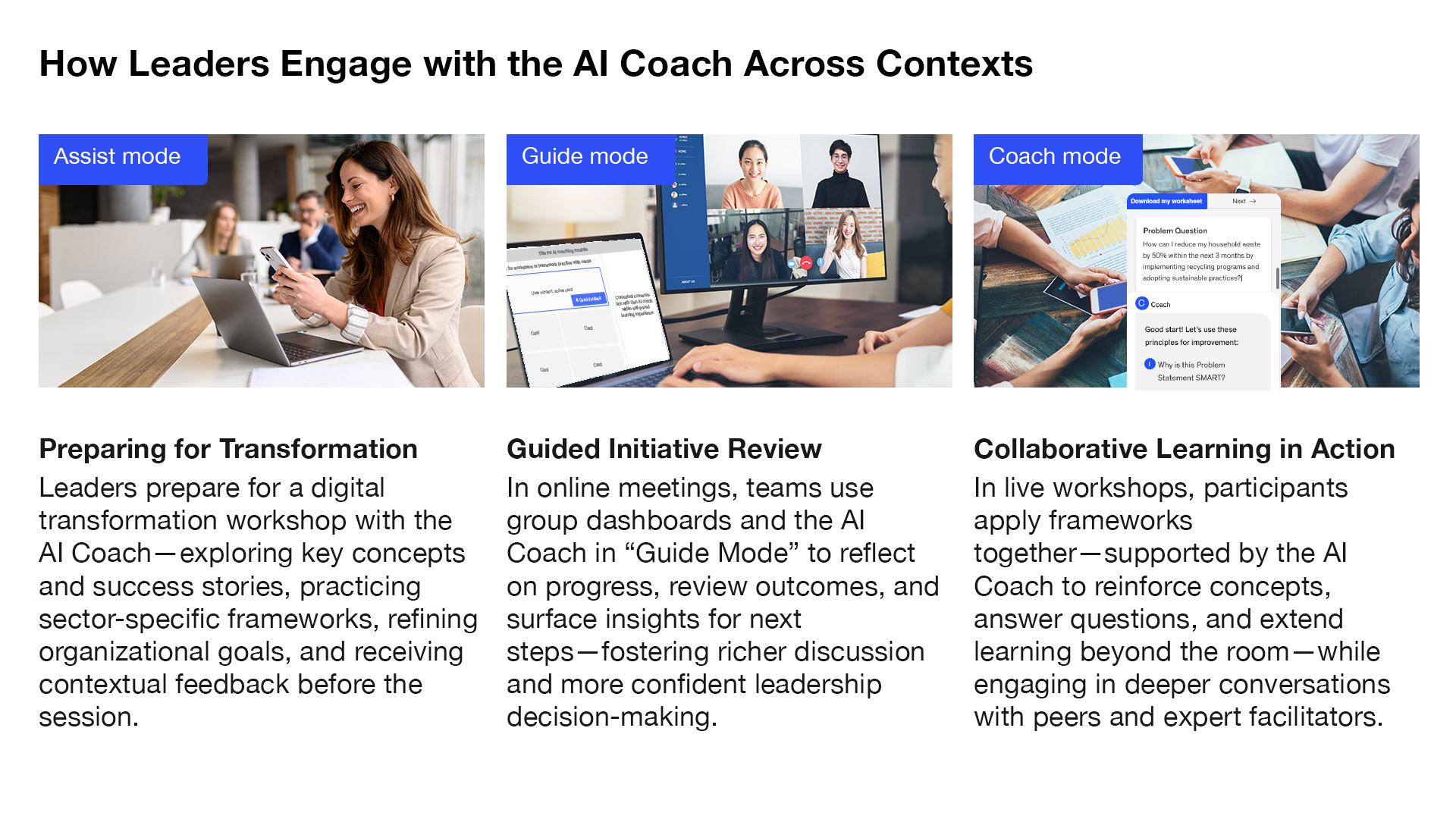
AI offered a way to simplify capability building and remove friction. I shaped and prioritized AI-assisted offerings within McKinsey Academy's learning portfolio — as standalone engagements or embedded in large-scale transformation programs for global clients. In under 6 months, I led and delivered the design for an AI-enhanced coaching model that scaled globally and set the foundation for future organizational learning.
"We helped people do and learn at the same time. The AI Coach prepared people for the events and milestones that matter, so they could succeed."
Challenge
How might we support personalized skill development and organizational change — at scale?
Collaboration & ownership
What I owned, who I led, and who I worked with.
- Accountability: End-to-end design leadership for three AI initiatives within McKinsey Academy’s portfolio — from strategy and workshops through MVP experiments, testing, and roadmap input.
- Team: Hands-on execution alongside a junior designer and PM; coaching on AI UX, design ops, and agile rituals; cross-functional rhythm with learning consultants and two technology teams.
- Stakeholders: Client-facing alignment so solutions stayed tied to transformation goals and real organizational constraints, not slide-deck abstractions.
Approach
Strategy & alignment
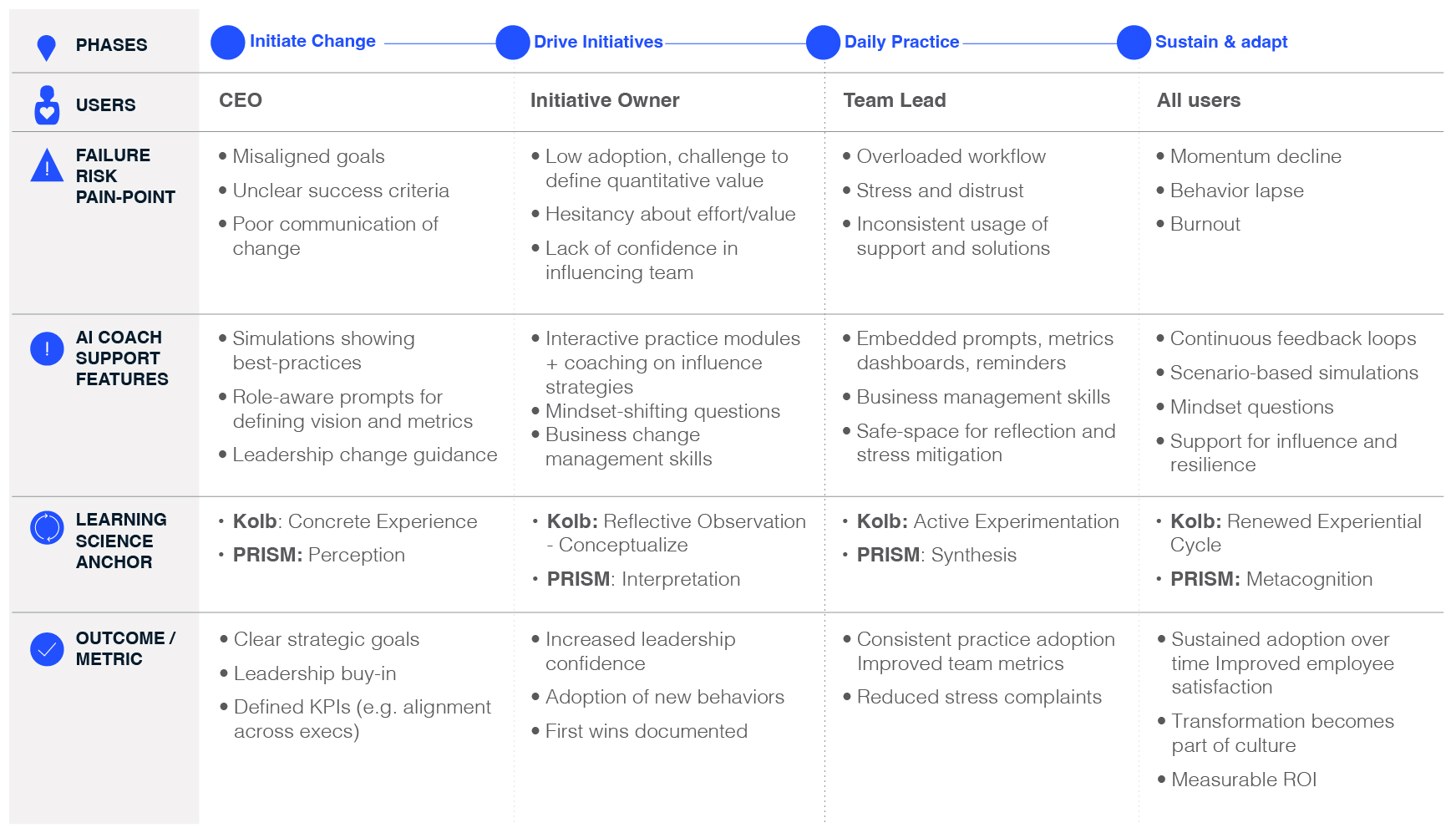
I led design strategy and stayed hands-on throughout. I aligned transformation goals with learning outcomes and mapped them to AI capabilities for coaching, personalization, and learning in the flow of work. I designed and ran the collaborative workshop to align stakeholders on goals, pain points, and use cases — guiding, assessing, tutoring, and coaching. I defined success metrics, designed the experiments for the MVP, and wrote the engagement plan so the delivery team could work autonomously with clear validation requirements and curated datasets.
Execution & team
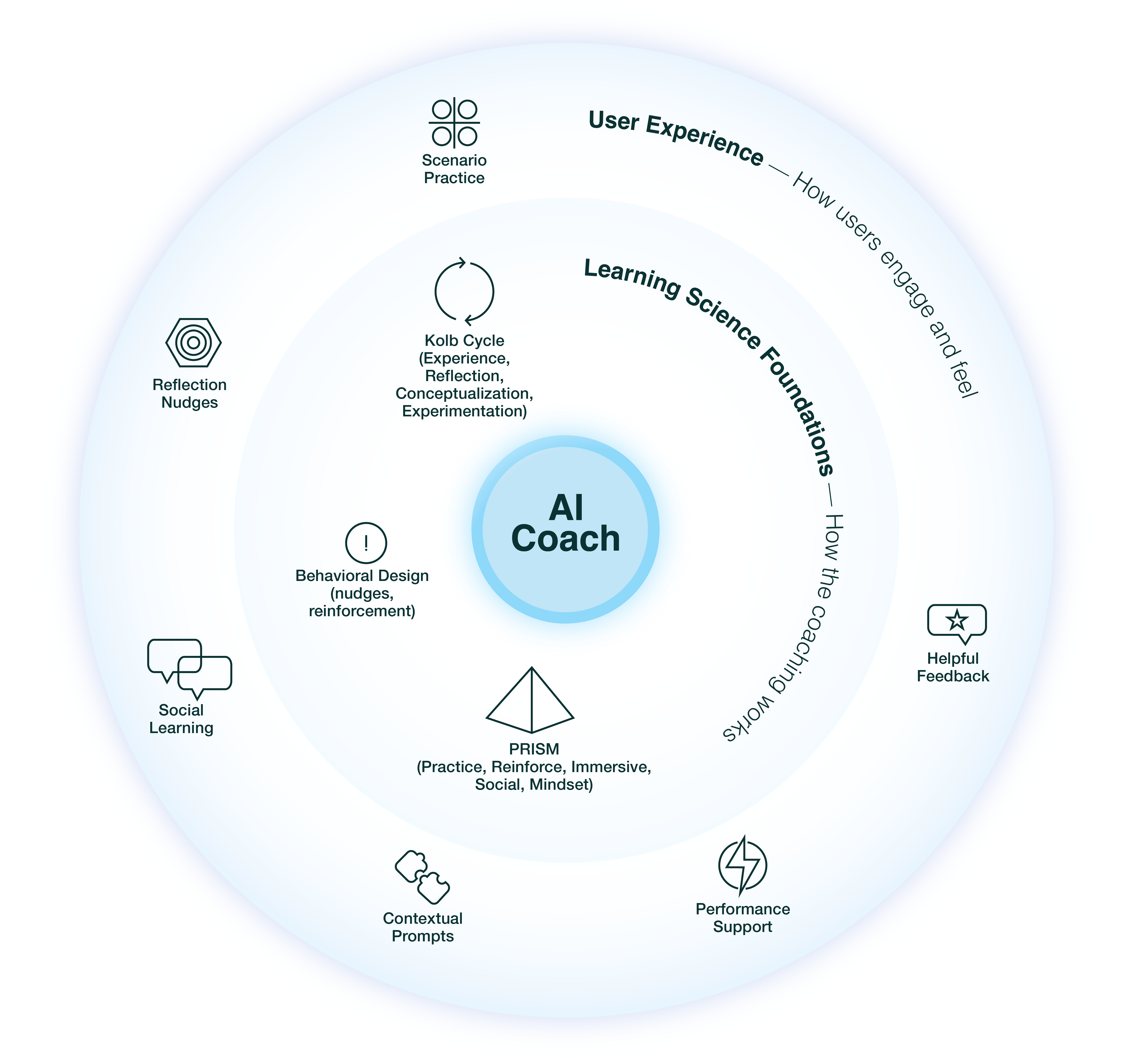
I extended the design system and component library for consistent patterns across the portfolio, mentored a junior designer and PM on AI UX and design ops, and embedded design ops and agile practices — boosting team capability by over 80%. I facilitated biweekly cross-functional sessions, synthesized prior UX work and learning-science research, and wrote design principles for learning and workflow myself. Staying close to client teams kept the work grounded in real organizational constraints.
Refinement & scale
Observing users led refinement and increased team confidence. I led this validation work through rapid prototyping, user testing, and cross-functional iteration.
- Prototyped interactive demos and fine-tuned models with curated examples — validating the coaching model and prompting leaders to revisit our hypothesis.
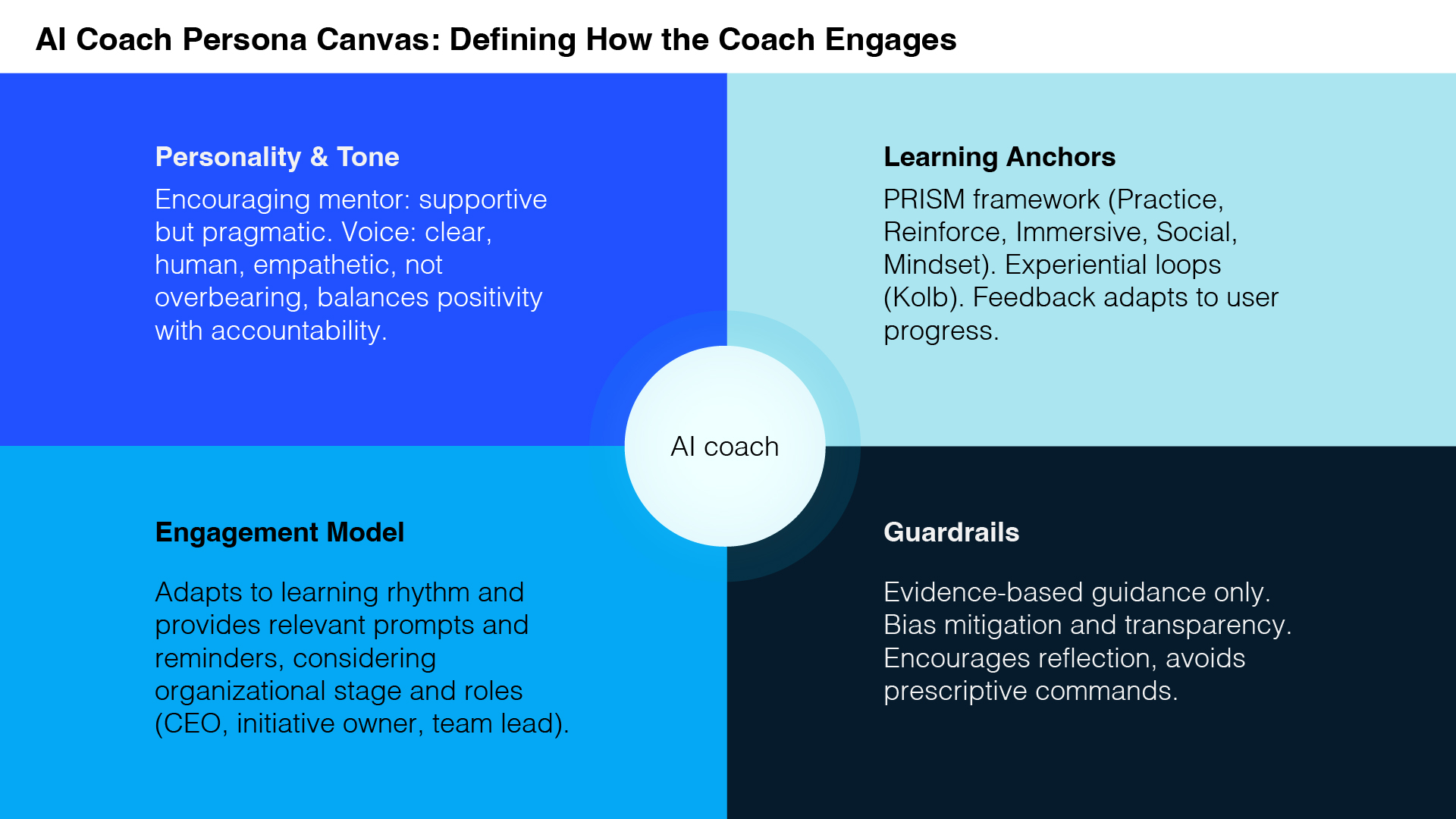
- Designed the AI experience for seamless mode, accessibility, and engagement, and wrote principles and guidelines for AI personality, conversational tone, and risk-mitigation flows.
- Led testing with learners and program managers and synthesized feedback on usability and learning outcomes; the junior designer refined the UI from that input while I iterated with engineering on model accuracy and guardrails.
- Advised on training materials and guided the roadmap so learnings translated into new offerings.
Results & learnings
Business takeaway
The program showed that evidence-based design plus responsible AI can move organizational learning from one-size-fits-all programs to in-flow capability building — with metrics leadership can stand behind (speed to value, reach, satisfaction).
What I’d repeat on the next engagement
- Ship, test, lead from the work. Short cycles of testing made the pilot credible; staying hands-on on prototypes and principles while upskilling the team kept quality and velocity aligned.
- Embed, don’t bolt on. Adoption climbed when coaching sat inside existing workflows and systems — not as another destination.
- Make the AI legible. Users trusted the experience when intent was clear and the model didn’t feel like a black box.
Longer term, healthy organizations still need human change management — but AI, when designed with guardrails, can remove friction from the hard work of learning and performing at the same time.
Testimonials
Minh Chau
Associate Partner, Director of Product Management
Colleague — McKinsey · January 30, 2026
"She is consistently reliable, delivering quality work while remaining open to diverse perspectives and to tackling new and challenging projects. Azul brings a positive energy to the team and a commitment to excellence in everything she does."
Team Leadership
Customer Experience
Enterprise Applications